-
dazemoonmarketing
- August 30, 2026
- No Comments
Author’s Note: This guide is based on established natural-stone industry practices and practical considerations used by architects, interior designers, builders, and marble professionals. Marble pricing can vary significantly depending on variety, grade, origin, slab quality, availability, processing, and project requirements. Buyers should inspect actual slabs and verify specifications before purchasing.
Table of Contents
- Introduction
- What Makes Italian Marble More Expensive?
- Italian Marble vs Indian Marble: Key Cost Factors
- Is Italian Marble Worth the Higher Price?
- Expert Tips for Buying Italian Marble
- Conclusion
- FAQs
Introduction
Italian marble has become synonymous with luxury interiors, premium architecture, and sophisticated residential design. From grand entrance foyers and expansive living rooms to designer bathrooms and feature walls, its distinctive appearance can transform an ordinary space into a high-end environment.
One of the most common questions homeowners ask is: Why is Italian marble more expensive than Indian marble?
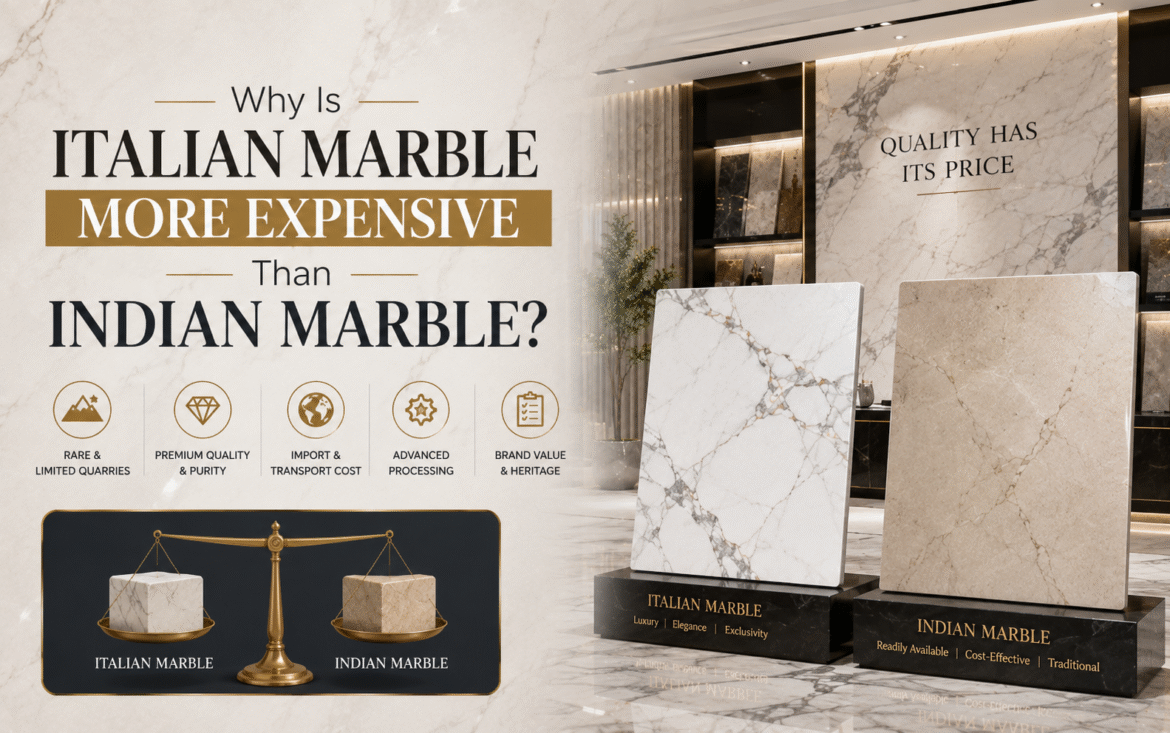
The price difference is influenced by several factors, including quarry characteristics, rarity, international transportation, processing, import-related costs, demand, and the unique visual qualities of particular marble varieties.
However, a higher price does not automatically mean that every Italian marble is technically better than every Indian marble. The right choice depends on the specific stone, application, design requirements, and budget.
For buyers exploring different varieties and price ranges, an experienced Marble supplier in Kishangarh can provide useful guidance on quality, origin, finish, and slab selection.
What Makes Italian Marble More Expensive?
1. Rarity of Certain Marble Varieties
One of the biggest factors affecting Italian marble prices is rarity. Some varieties are quarried from limited geological deposits, making particular colors and patterns difficult to source consistently.
Rare white backgrounds combined with distinctive grey or gold veining are especially sought after in luxury architecture. When supply is limited but demand remains high, the market value of the stone can increase.
2. Quarrying and Extraction
Natural stone extraction is a specialized process. Large blocks must be carefully removed from quarries to minimize breakage and preserve usable material.
The characteristics of the quarry itself also influence production. Geological conditions, block size, accessibility, and extraction yield can all affect the final cost of a marble slab.
3. Import and Transportation Costs
Unlike locally sourced stone, imported marble must travel internationally before reaching the Indian market. The overall supply chain can involve quarrying, block transportation, international shipping, customs procedures, warehousing, and domestic transportation.
These additional stages naturally contribute to the final price paid by the consumer.
4. Processing and Finishing
Premium marble slabs undergo cutting, calibration, polishing, finishing, and quality inspection. High-quality processing helps reveal the stone’s natural character while producing a surface suitable for luxury applications.
The cost can increase further when buyers select large-format slabs, special finishes, or custom fabrication.
5. Distinctive Aesthetic Appeal
Italian marble is particularly valued for its visual characteristics. Some varieties feature dramatic veining and bright backgrounds that create a sophisticated appearance impossible to reproduce exactly with artificial materials.
This makes the stone especially attractive for statement interiors where the marble itself becomes a design element.
Homeowners researching Italian marble in Kishangarh can compare different varieties to understand how background color, veining, slab size, finish, and grade influence pricing.
Italian Marble vs Indian Marble: Key Cost Factors
Indian marble can be considerably more economical because it is sourced domestically and generally involves a shorter supply chain. India also has extensive marble resources and produces numerous varieties suitable for residential and commercial applications.
However, price should not be the only consideration.
| Factor | Italian Marble | Indian Marble |
|---|---|---|
| Origin | Imported | Domestic |
| Transportation | International + domestic | Primarily domestic |
| Design range | Highly distinctive premium patterns | Broad range of colors and patterns |
| Rarity | Some varieties are extremely rare | Varies by variety |
| Luxury appeal | Very high for premium varieties | Can also be highly premium |
| Price | Often higher | Generally more accessible |
| Maintenance | Depends on variety and finish | Depends on variety and finish |
A professional Marble dealer in Kishangarh can help buyers compare specific varieties instead of assuming that all imported marble or all Indian marble has the same characteristics.
Is Italian Marble Worth the Higher Price?
For many luxury projects, the answer can be yes.
Italian marble can provide a combination of natural variation, refined appearance, and exclusivity that makes it particularly valuable in premium interiors. It is often selected for areas where visual impact matters most, such as entrance halls, living rooms, staircases, master bathrooms, and feature walls.
However, purchasing expensive marble simply because it is imported is not always the best approach. A homeowner should consider whether the selected variety actually suits the application.
For example, a dramatic marble may be ideal for a feature wall but unnecessary for every bedroom floor. A practical design strategy can combine premium marble in prominent areas with more economical materials elsewhere.
Visiting the Best marble shop in Kishangarh can help buyers compare complete slabs and understand the difference between varieties before committing to a large purchase.
Expert Tips for Buying Italian Marble
Inspect Actual Slabs
Photographs cannot fully represent natural marble. Veining, color movement, mineral characteristics, and surface appearance can look significantly different on a full slab.
Verify Specifications
Ask about origin, thickness, finish, dimensions, grade, and recommended applications. This information helps ensure that the selected marble is suitable for the project.
Compare Multiple Slabs
Natural stone varies from slab to slab. Comparing several pieces can help you select a more consistent batch or identify the pattern that best suits your interior.
Consider Installation Costs
The final project budget includes more than the marble itself. Transportation, cutting, installation, polishing, sealing, wastage, and fabrication can all affect the overall cost.
Choose an Experienced Supplier
Working with a Premium marble supplier india can simplify sourcing and provide access to both domestic and imported collections. Professional guidance is particularly useful when selecting high-value marble for large residential projects.
For buyers specifically searching for premium Italian collections, the Best Italian marble in Kishangarh can be evaluated by comparing actual slabs, origin, pattern, quality, and suitability rather than choosing purely on price.
Similarly, if you are considering different international varieties, researching the Best Imported marble in india can help you compare materials based on aesthetics, quality, availability, and long-term requirements.
Conclusion
Italian marble is generally more expensive than Indian marble because of a combination of rarity, quarrying conditions, international transportation, processing, import-related expenses, and strong demand for distinctive premium varieties.
However, expensive does not always mean better for every project. The most suitable marble is the one that provides the right balance of aesthetics, performance, maintenance, availability, and budget.
For luxury homes, Italian marble can be an excellent investment when selected carefully and installed professionally. Buyers should focus on the specific marble variety and actual slab quality, rather than making a decision based solely on its country of origin.
Frequently Asked Questions
1. Why does Italian marble cost more than Indian marble?
Italian marble can cost more because of international transportation, import-related expenses, quarry rarity, processing, limited availability, and demand for exclusive patterns.
2. Is Italian marble better than Indian marble?
Not necessarily in every situation. Both can offer excellent quality. Italian marble is often chosen for distinctive luxury aesthetics, while Indian marble can provide excellent value and variety.
3. Which Italian marble varieties are expensive?
Rare varieties with exceptional white backgrounds, dramatic veining, limited quarry production, and high demand tend to command premium prices. Statuario and certain Calacatta varieties are notable examples.
4. Does Italian marble require special maintenance?
Like other natural marble, Italian marble benefits from proper cleaning, appropriate sealing, and protection from acidic substances. Maintenance requirements vary according to the specific stone and finish.
5. How can I avoid overpaying for Italian marble?
Compare actual slabs, verify the marble’s origin and specifications, obtain quotations from reputable suppliers, understand installation and wastage costs, and choose a variety based on your project’s actual requirements rather than popularity alone.