
-
dazemoonmarketing
- September 20, 2026
- No Comments
Table of Contents
- Introduction
- What Is Premium Marble?
- Premium Marble vs Regular Marble: Key Differences
- Factors That Determine Marble Quality
- How to Choose Premium Marble for Your Project
- Installation and Maintenance Considerations
- Conclusion
- Frequently Asked Questions
Introduction
Marble has long been associated with elegance, durability, and architectural beauty. However, not all marble offers the same level of quality, appearance, or performance. The difference between premium and regular marble can influence the overall look of a space, maintenance requirements, longevity, and even the value of an interior project.
Premium marble is generally selected for projects where aesthetics, consistency, surface quality, and long-term performance are important. Regular marble can also be a practical option, particularly when budget is a major consideration. Understanding the differences between the two helps homeowners, architects, builders, and interior designers make better material decisions.
For buyers exploring natural stone options, consulting an experienced Marble supplier in Kishangarh can provide access to different marble varieties and professional guidance based on project requirements.
What Is Premium Marble?
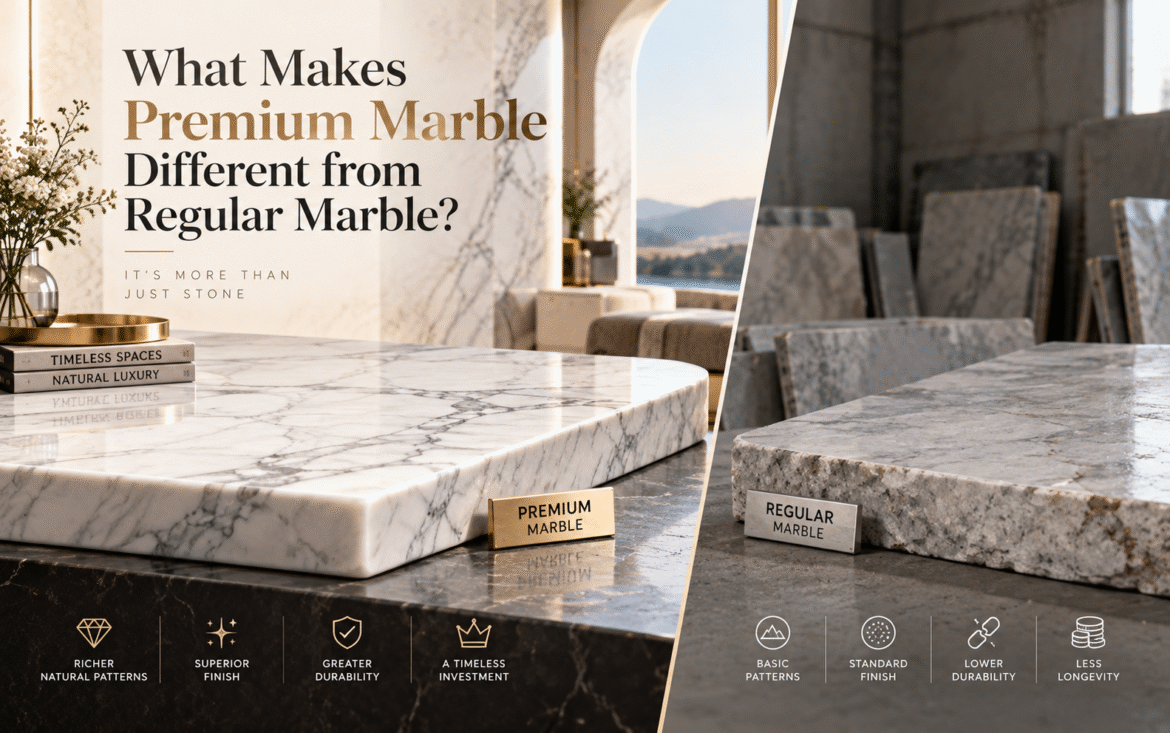
Premium marble refers to carefully selected natural stone that offers desirable characteristics such as attractive veining, consistent coloration, superior finishing potential, fewer visible imperfections, and good structural quality.
The term “premium” does not necessarily mean that every premium marble is stronger than every regular marble. Marble is a natural stone, so its characteristics vary depending on its geological origin, variety, quarry, and individual slab. Premium classification often reflects a combination of appearance, rarity, consistency, selection, and processing quality.
Premium marble is commonly used in luxury residences, hotels, commercial spaces, high-end bathrooms, feature walls, flooring, staircases, and statement furniture.
Premium Marble vs Regular Marble: Key Differences
1. Appearance and Veining
One of the most noticeable differences is visual character. Premium marble often features more distinctive veining, balanced patterns, attractive backgrounds, and greater consistency from slab to slab.
Regular marble may still look beautiful, but its patterns can be less predictable. Premium selections are often made specifically to achieve a particular visual effect, especially in projects involving large surfaces or bookmatched installations.
2. Surface Quality
Surface quality is another important factor. Premium slabs are generally selected for better finishing characteristics, fewer distracting surface imperfections, and a refined appearance after polishing.
A reliable Marble dealer in Kishangarh can help buyers inspect slabs carefully before purchase rather than selecting marble based only on photographs or small samples.
3. Rarity and Origin
Some marble varieties are considered premium because of their limited availability, distinctive geological characteristics, or specific quarry origin. Imported stones can also command higher prices because of their unique colors and patterns, transportation requirements, processing, and availability.
For example, Italian marble in Kishangarh is available in a variety of styles and is often selected for luxury interiors because of its distinctive appearance and design versatility.
4. Slab Selection and Consistency
Premium projects often require careful slab selection. Designers may need slabs with compatible tones and vein directions to create visual continuity across floors, walls, countertops, or feature areas.
Regular marble can be suitable for smaller applications where exact slab-to-slab consistency is less important. However, for large luxury installations, consistency can significantly influence the final appearance.
5. Finishing Potential
The quality of cutting, calibration, polishing, and finishing can greatly affect how marble looks after installation. A high-quality slab combined with skilled processing can produce a smooth and visually refined surface.
This is why buyers should evaluate not only the stone itself but also the expertise of the supplier and fabricator.
Factors That Determine Marble Quality
Several factors should be considered when evaluating marble:
- Color and background: A balanced and attractive base color can improve the overall design.
- Veining: Veins should complement the intended aesthetic rather than create unwanted visual distractions.
- Surface condition: Excessive cracks, pits, or other visible imperfections may affect suitability.
- Thickness and consistency: Appropriate thickness and uniformity are important for fabrication and installation.
- Finish: Polishing quality can significantly influence the final appearance.
- Application: Flooring, walls, stairs, countertops, and bathrooms may require different selection criteria.
- Maintenance expectations: Some marble varieties may require more careful sealing and maintenance than others.
A Best marble shop in Kishangarh can offer multiple varieties and allow customers to compare actual slabs according to color, pattern, finish, and application.
How to Choose Premium Marble for Your Project
Start by defining the purpose of the marble. A flooring project may prioritize durability, consistency, and slip considerations, while a feature wall may focus more heavily on pattern and visual impact.
Next, inspect full-size slabs whenever possible. Small samples cannot always represent the complete pattern of natural stone. Ask about the marble’s origin, available thicknesses, finishing options, expected maintenance, and installation requirements.
Budget should also be considered realistically. A Premium marble supplier india may offer multiple quality levels, allowing buyers to select a stone that balances appearance, performance, and project cost.
For projects specifically seeking distinctive imported varieties, comparing several slabs is particularly useful. Buyers looking for the Best Italian marble in Kishangarh should evaluate the actual stone rather than relying solely on the name of the variety.
Installation and Maintenance Considerations
Even high-quality marble requires proper installation and maintenance. The substrate should be appropriately prepared, slabs should be handled carefully, and suitable adhesives and installation methods should be selected according to the application.
After installation, regular cleaning with suitable stone-care products helps preserve the surface. Acidic or highly abrasive cleaners should generally be avoided because marble is susceptible to etching and surface damage.
Sealing requirements can vary depending on the marble and application. Professional advice can help determine an appropriate maintenance schedule.
For buyers comparing Best Imported marble in india options, it is important to consider the complete ownership experience—not simply the initial purchase price. Transportation, fabrication, installation, sealing, maintenance, and replacement considerations can all contribute to the total project cost.
Conclusion
The main difference between premium and regular marble lies in the combination of appearance, selection, consistency, processing quality, rarity, and suitability for the intended application. Premium marble can provide a more refined and distinctive appearance, particularly when carefully selected and professionally installed.
However, “premium” should not be treated as a universal guarantee of superior performance. The right marble depends on the project, application, budget, design requirements, and maintenance expectations. Buyers should inspect actual slabs, understand the stone’s characteristics, and work with experienced professionals before making a final decision.
Frequently Asked Questions
1. Is premium marble stronger than regular marble?
Not necessarily. Premium classification often relates to appearance, rarity, selection, consistency, and finishing quality. The structural performance of marble depends on its specific variety and characteristics.
2. Why does premium marble cost more?
Premium marble may cost more because of factors such as rarity, origin, distinctive veining, better slab selection, processing quality, transportation, and availability.
3. How can I identify high-quality marble?
Look for consistent thickness, suitable surface quality, attractive and appropriate veining, minimal undesirable imperfections, and good finishing potential. Professional inspection is recommended before purchase.
4. Is imported marble always better than Indian marble?
No. Imported and Indian marble both offer different characteristics and varieties. The best choice depends on the project’s design, performance requirements, budget, availability, and maintenance expectations.
5. Does premium marble require special maintenance?
Marble generally requires appropriate cleaning and periodic care. Depending on the stone and application, sealing may also be recommended. Avoiding harsh acidic cleaners can help protect the surface and finish.